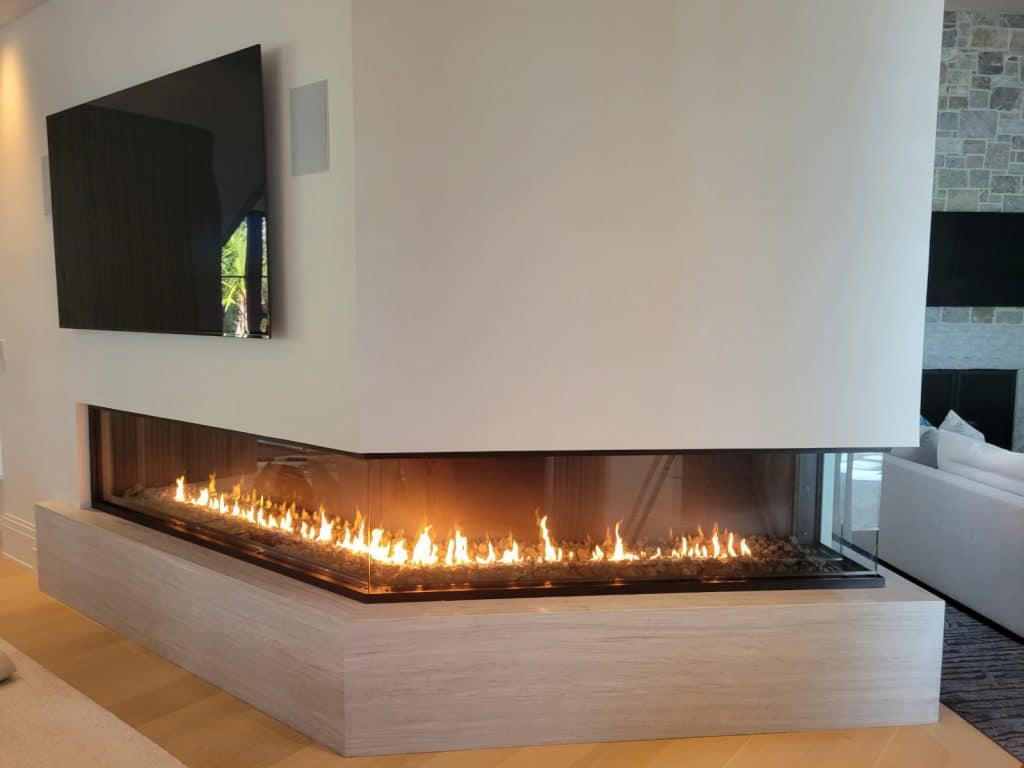
Start with the symptom, not a parts catalog
Troubleshooting is the right booking when you already know something is wrong. The fireplace clicked all last winter and now it does nothing. The remote batteries are new and the receiver still ignores you. There is a pop when it lights. The glass blackens in a single evening. Those are diagnostic problems. A full seasonal inspection is still valuable, but it is not what you need at 7 p.m. on the first cold night in Olmos Park.
For $69 we come to the house, reproduce the symptom, and trace it to a component or a setting. Common outcomes in San Antonio: a thermocouple that cannot hold the valve, a thermopile too weak to drive the wall switch, an igniter that will not spark after sitting through a humid summer, a vent cap packed with mud daubers on a west-facing wall, or a gas shutoff that someone closed during a remodel and never reopened.
What we ask you before the visit
Tell us whether you have a standing pilot or a click-to-light system, whether the wall switch does anything, and whether you smell fuel. If you know the brand — Heatilator on a builder fireplace in Alamo Ranch, Napoleon in a remodel off Broadway, Empire logs in an older masonry opening — put that in the details field. Zip code matters because propane still shows up on lots toward Helotes and west of Boerne, and propane orifices are not interchangeable with natural gas.
No light, no spark, no click
Electronic ignition needs power at the module and a clean electrode. We check batteries, transformers, and the spark path before condemning the module. Millivolt systems need a live thermopile and a closed switch loop. A “dead” fireplace is often a disconnected wall switch from a TV install over the mantel.
Lights, then shuts down
That pattern is usually a sensor, an ODS on a vent-free unit, or a blocked vent overheating the system. We do not jump to a new valve until the millivolt readings and the cap are checked. Overheating from a blocked termination is common on single-story homes where the side-wall kit sits in shrubs along a side yard.
A practical order of checks
We do not start by ordering a valve. The sequence is shutoff position, vent cap, power at the control, pilot quality, millivolt or spark readings, then the valve and the remote path. That order exists because the cheap problems are also the common ones in this city. A closed key valve behind a new TV wall is not a failed fireplace. A receiver with dead batteries is not a failed fireplace. We still charge the diagnostic because the visit is how you find that out without guessing on a Saturday night.
Bring anyone else in the house up to speed on the symptom. “It worked in February” is useful. “We smelled something once in March” is useful. “The installer from 2012 said it always pops” is useful because delayed ignition is not a quirk we will bless. If a prior company left a note, keep it. We would rather agree or disagree with a written finding than start from zero.
After the diagnostic
Three outcomes: we fix it on the spot with a truck part, we schedule a return with an ordered part, or we tell you the appliance is not worth repairing. The third outcome is rare and we do not enjoy it, but a rusted-through firebox is not a $69 conversation that turns into a miracle. You can take that report to whoever sells new units. Our troubleshooting fee still covers the finding.
Odor, soot, or a whoosh on ignition
Delayed ignition means gas is pooling before it lights. That is a safety finding. We look at the valve opening speed, burner ports, and whether logs have been rearranged for a “prettier” flame. Soot on the surround is incomplete combustion until proven otherwise. Cleaning may be the whole fix; sometimes a valve or a crushed vent is behind it. Either way, the diagnostic names the cause before repair work starts.
If we arrive and the unit is simply overdue for a full tune-up with no single failed part, we will tell you and you can convert the visit. We will not pad a diagnostic into a replacement quote because a store would. Serving San Antonio, New Braunfels, Schertz, Boerne, and Helotes.